THE ROOT OF THE SORROW
Eight Centuries Of English Occupation
“It was a machine of as wise and elaborate contrivance for the impoverishment and degradation of a people, and the debasement, in them, of human nature itself, as ever proceeded from the perverted ingenuity of man.”
— EDMUND BURKE, Irish statesman and philosopher, describing the British Penal Laws.
To view the Great Hunger of the 1840s as a tragedy born primarily of an agricultural failure is a profound misreading of history. The arrival of phytophthora infestans was merely the ecological trigger that set off a catastrophe centuries in the making. An Gorta Mór was the inescapable climax of an 800-year process of systematic colonial extraction, cultural erasure, and economic strangulation engineered by the English state. The mass starvation was not a bizarre accident of nature; it was the arithmetic result of British imperial policy.
Clash Of Systems
The devastation did not begin in the 1840s, but in 1169. The invasion sparked a centuries-long collision between two incompatible worlds: English feudalism and the ancient Gaelic order governed by Brehon Law. Recognizing that military conquest alone could not subjugate the culture, the Crown turned to legislative suppression.
The Statutes of Kilkenny (1367) forbade colonists from intermarrying with the Irish, speaking the language, or wearing Irish dress. The native population was officially categorized as “Irish enemies,” establishing a racial hierarchy that would justify centuries of subsequent violence.
Weaponizing Land
The 16th and 17th centuries marked a shift toward “Plantations”—conquest by colonization. The Crown systematically confiscated millions of acres of prime agricultural land from native Catholic aristocracy and granted it to Protestant settlers. This was the deliberate decapitation of the Gaelic social order, transforming native owners into landless tenants.
The systemic dispossession was accelerated by Oliver Cromwell (1649–1653). His Act of Settlement sanctioned the wholesale theft of remaining Catholic-owned land. Native families were issued a lethal directive: transplant to the bog-ridden lands of Connacht, or face execution. “To Hell or to Connaught.”
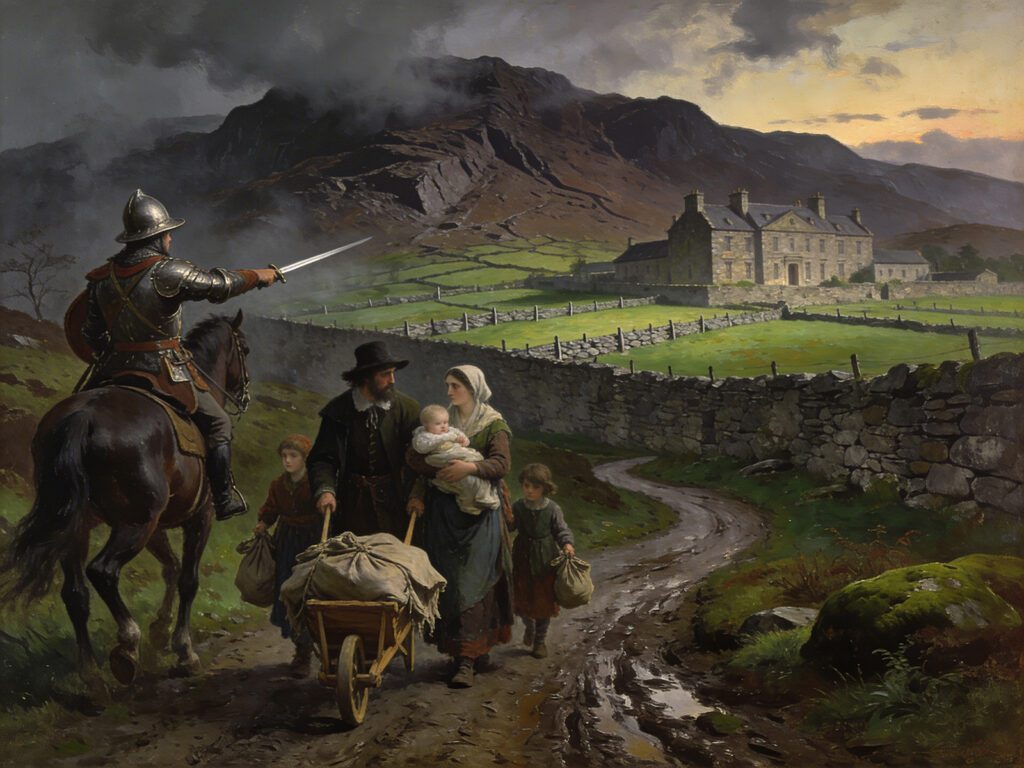
The Dispossession: Irish families driven westward during the Cromwellian Plantations.
Penal Laws
Implemented in the 18th century, the Penal Laws were a masterclass in social engineering designed to ensure Irish Catholics remained permanently impoverished. They were disenfranchised, barred from public office, and denied an education. Their language was outlawed, and their spiritual life was criminalized.
Most devastating were inheritance laws that forced Catholic land to be subdivided equally among all heirs. Generation by generation, Irish farms were splintered into microscopic, unviable plots. It was a legally mandated descent into inescapable destitution.
Manufactured Scarcity
By 1845, the native Irish were trapped in a horrifying paradox. They raised millions of bushels of grain and beef on some of the world’s most fertile soil, yet they were forced to export it all to pay rent to absentee landlords. Forced onto microscopic plots, they relied on a single crop to survive.
When the blight turned the potato fields to black rot, it did not strike a resilient nation. It struck a population balancing on a socio-economic precipice deliberately constructed by eight centuries of English colonial policy. The catastrophe was not an accident; it was a harvest of tyranny.
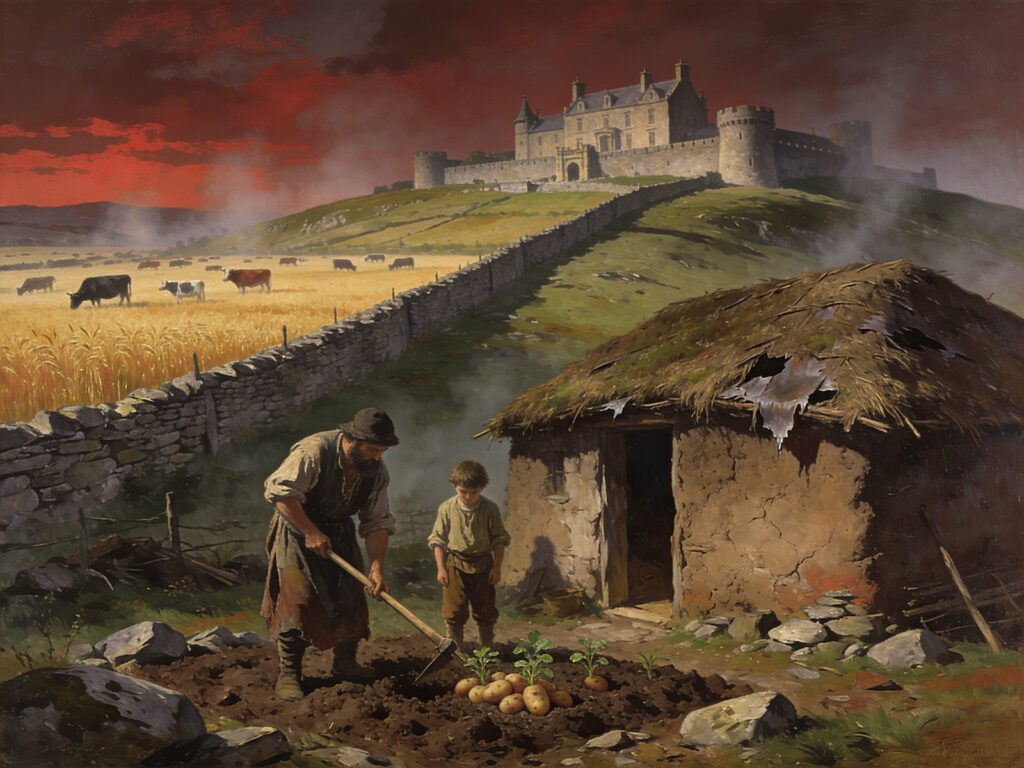
Manufactured Scarcity: A peasant family outside their cabin as the wealthy estate prospers in the distance.